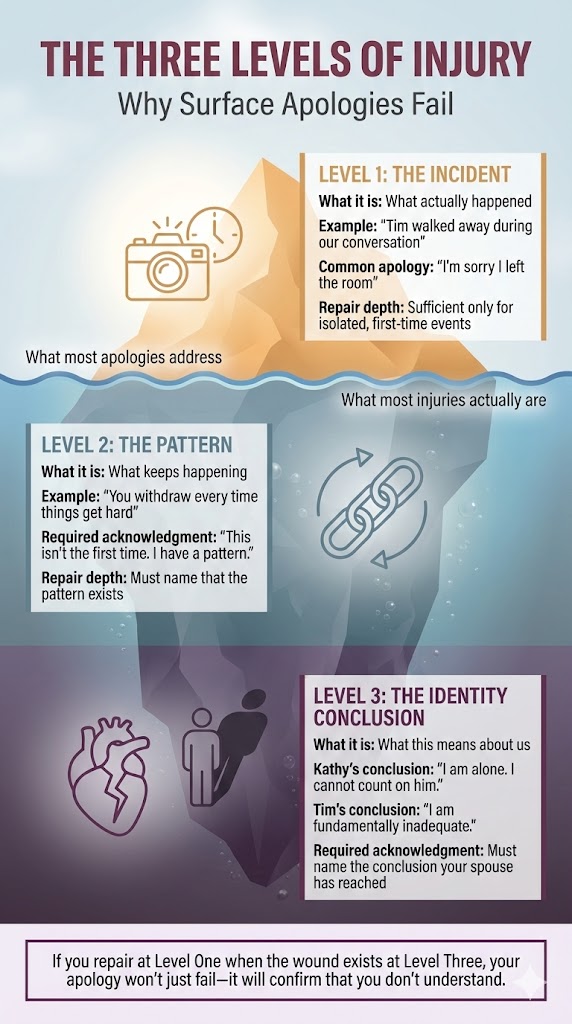
An apology is a transaction; repair is a transformation. Research on repair attempts found that acceptance rate -- not the attempt itself -- is what actually distinguishes stable couples, and acceptance depends on matching the depth of the repair to the depth of the wound. A Level 1 "sorry" doesn't reach a Level 3 injury like "I must not matter to you" -- today's work is classifying the wound honestly before attempting the repair.
Tap to view full size
This is the exact classification your first activity today asks you to make. Notice the required acknowledgment gets more specific at each level -- Level 2 needs you to name that a pattern exists, Level 3 needs you to name the conclusion your partner actually reached ("I am alone," "I am fundamentally inadequate"). Repairing at the wrong level doesn't just fail; per this diagram's own closing line, it confirms you don't understand.
Wound Classification
Identify a wound you caused. Classify it: Level 1 (specific incident), Level 2 (recurring pattern), or Level 3 (what it made them believe about themselves or the relationship). A Level 1 apology -- "I'm sorry I did that" -- will not heal a Level 3 wound like "I must not matter to you."
Your response here isn't saved yet -- that lands with activity persistence, a later step.
The Three-Part Repair
Practice the Three-Part Repair: (1) Own the action: "I withdrew when you needed me." (2) Name the impact: "I understand that made you feel abandoned and like I do not care about you." The naming of the impact is what brings healing -- do not rush past it. (3) Commit to change: "Next time I am overwhelmed, I will ask for 20 minutes and promise to return."
Your response here isn't saved yet -- that lands with activity persistence, a later step.
Reflect with your coach
Did you classify the wound honestly (Level 1, 2, or 3) before choosing your repair, or did you default to a Level 1 "sorry" regardless of what actually happened?
Day 18 of 28