Every couple has a cycle. One person pursues, the other withdraws -- or both escalate, or both go cold. The pattern runs the marriage until you name it.
Tap to view full size
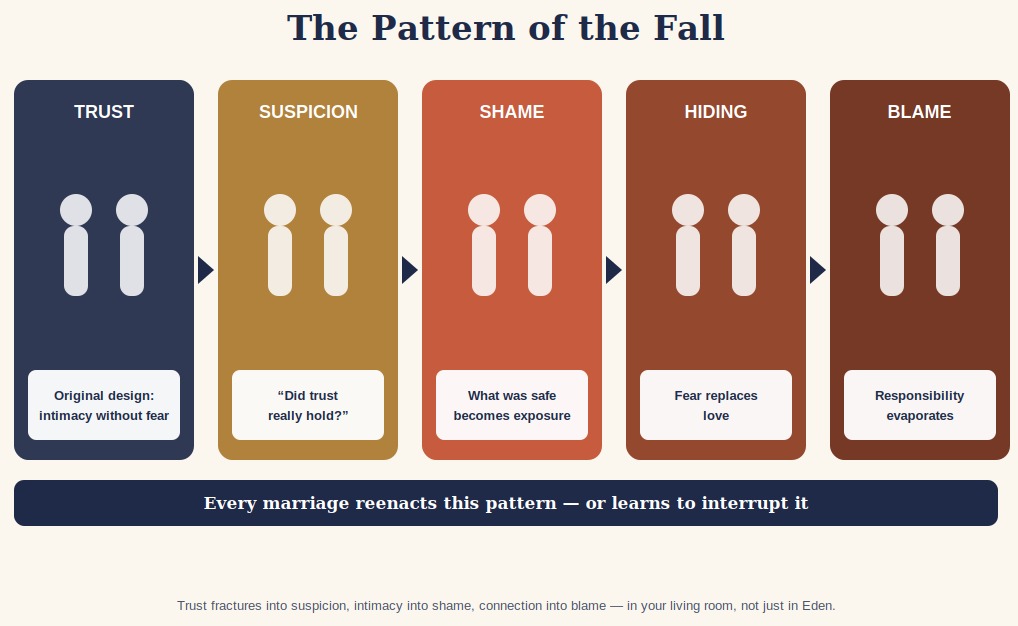
This is the shape of the pattern you're about to map. You don't have to match it stage for stage -- the point is that pursuing, withdrawing, escalating, or freezing are all just different places to get stuck on this same slide. Naming which stage you tend to freeze at is what the next two solo exercises are asking for.
Name Your Pattern
Are you the pursuer (criticize, cling, demand when stressed) or the withdrawer (go silent, leave the room, shut down)? Write: "When conflict happens, I typically…" -- be specific: include your tone, your body language, what you actually say. Then ask what's underneath it: what fear or old wound is this move actually protecting? Every marriage reenacts some version of the same five-stage collapse -- trust curdling into suspicion, suspicion into shame, shame into hiding, hiding into blame -- so also note which of those five stages (Trust, Suspicion, Shame, Hiding, Blame) you tend to freeze at.
Your response here isn't saved yet -- that lands with activity persistence, a later step.
The Invisible Guests: Family of Origin Inventory
You are not just the product of your choices; you are the product of your childhood home, and the patterns you learned there are running like invisible software in your marriage. Answer honestly: (1) In my childhood home, conflict was handled by -- circle all that apply: yelling and explosions / cold silence and avoidance / pretending nothing happened / physical intimidation or violence / humor and deflection / calm discussion (rare, but possible). (2) In my childhood home, love was shown by: words of affirmation / acts of service / gifts / physical affection / the absence of criticism (love was assumed, not expressed). (3) The pattern I most want to KEEP from my family is ___. (4) The pattern I most want to BREAK from my family is ___. (5) When I am stressed, I default to my [mother's/father's] pattern of ___. Then, the next time you catch yourself repeating one of these patterns, use the Eviction Script to interrupt it out loud: "I'm feeling the urge to [shut down / attack / control / withdraw], just like [parent]. But I'm not them. I'm choosing to [stay present / soften / listen / speak my need]."
Your response here isn't saved yet -- that lands with activity persistence, a later step.
Name the Cycle Together
Share your self-assessment: "When we fight, I do [pattern]. I think it comes from [fear or history]. What I am really trying to do is [protect myself / get closer / feel safe]." After both partners share, name the cycle together: "Our pattern is [X]." Write it down.
Your response here isn't saved yet -- that lands with activity persistence, a later step.
Reflect with your coach
What's the fear or old wound underneath your pattern, and whose pattern from your childhood does it most resemble?
Naming your pattern is an act of humility, not self-condemnation. You cannot listen quickly if you don't yet know what you reflexively do when conflict starts.
Day 2 of 28