Dr. John Gottman can predict divorce with over 90% accuracy by watching for four specific communication patterns. None of them are personality defects -- every one has a specific, researched antidote. The work today is naming which one is yours, without excusing it, so the antidote can actually be applied.
Tap to view full size
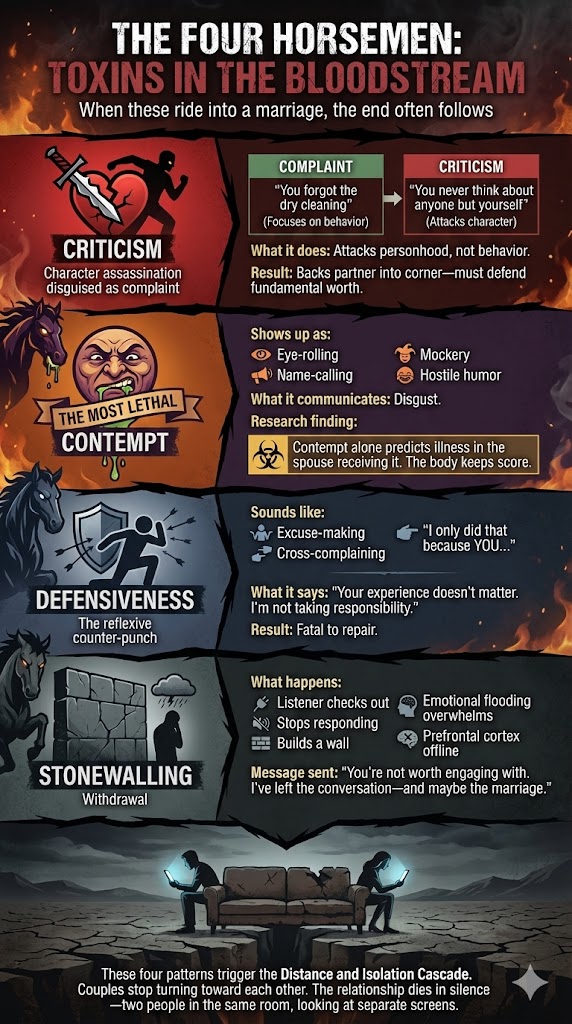
This names, in plain language, exactly what today's naming exercise asks you to identify in yourself. Contempt is flagged here as the most lethal -- Gottman's research found it alone predicts illness in the partner receiving it -- so if that's your Horseman, don't downplay it as 'just sarcasm.' The diagram's own closing line (these four patterns trigger the Distance and Isolation Cascade) is the same slow-motion collapse your relapse plan on Day 24 is built to catch early.
Name Your Horseman
Which Horseman is your default? Criticism (attacking character instead of addressing behavior), Contempt (superiority, eye-rolling), Defensiveness (counterattack, refusing responsibility), or Stonewalling (shutdown, withdrawal, checking out)? Write the last three times you used it. Be brutally specific about what you said or did.
Your response here isn't saved yet -- that lands with activity persistence, a later step.
Own It Together
Each person shares: "My primary Horseman is [name it]. The last time I used it was [specific example]. When I do this, you probably feel [name their experience]. I commit to [the antidote]." Then agree on an intervention: if either person hears a Horseman, say gently, "I think I just heard [Horseman]. Can we try that again?" This gives a do-over. Most conflicts can be avoided by catching the Horseman in the first 30 seconds.
Your response here isn't saved yet -- that lands with activity persistence, a later step.
Reflect with your coach
Are you naming your own Horseman honestly -- not your partner's -- and specific enough that you'd actually recognize it happening again?
Confession isn't about shame -- it's about healing. Naming your Horseman out loud, without excusing it, is the same movement as confession: bringing what's hidden into the light so it can be treated.
Day 4 of 28